LLMs can potentially represent a new approach to computing architecture

Traditional von Neumann architecture computers typically use procedural programming languages that store data in registers and perform calculations using the CPU. Another type of computer architecture executes programs functionally, solving parallel problems through the transformation of data. Erlang runs on a virtual machine. In this architecture, programs are executed functionally by transforming data and can work with parallel computing while operating within a virtual machine.
I think maybe we can consider LLMs (and similar architectures) as a new type of computer architecture running on a GPU “virtual machine”.
I googled and found the most relevant article is from the a16z fund: https://a16z.com/emerging-architectures-for-llm-applications/
I say that because as you increasingly use LLMs like ChatGPT or LLAMA, you’ll notice that the results obtained from a single prompt often require repeated adjustments and revisions, needing new prompts to achieve accurate feedback.
If we consider the process itself, which consists of initial prompt -> reviewing the result -> fine-tuning -> continued prompt as a new approach to programming instead of just assuming that achieving the desired outcome can be done through a single prompt alone, then indeed it brings forth a new programming paradigm. I discussed this topic with ChatGPT, and it created a picture using python for me which I found interesting.
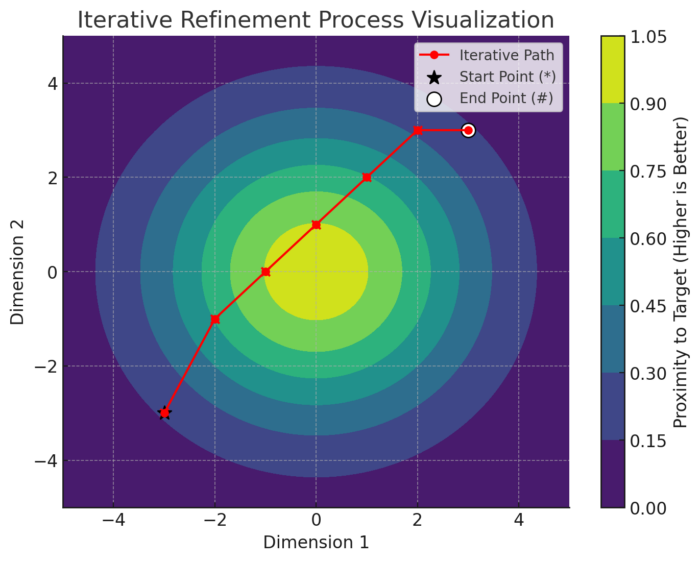
The meaning of this picture is to achieve the desired result by starting with an initial prompt and then progressively increasing and finally reducing dimensions(because the text is generated, these characters represent information in a high-dimensional mathematical form like semantics, context, and sentence structure, all contained within each character). Exploring this aspect might be helpful for my recent considerations of 24×7 LLM. I searched Twitter, and some people are also thinking about similar things.